

Chekhov is generally considered to be an atheist, but his letters are studded with religious references, especially around Easter, the most profound Christian holiday and an especially important one in Russia. “Christ is risen!” he exclaimed in letters each spring, year after year. This may be not much different than a non-observant modern American typing “Merry Christmas” in a text to a friend, but the sentiment in Chekhov’s letters seems more fervent and not performative in the least.
I tend to believe that Chekhov was a religious skeptic who nevertheless felt the pull of Christianity deeply, and was comforted by it even as he doubted it.
Near the beginning of the story “Easter Eve,” an unnamed narrator stands at a riverbank waiting for a ferry to carry him to a monastery where the Easter Vigil is to be celebrated. He looks up at the sky and says that the stars “had come out for the festival procession, every one of them, little and big, washed, renewed and joyful, and every one of them was softly twinkling its beams.”
I have to believe that the unnamed narrator is Chekhov himself.
This is the story: The narrator is visiting a monastery to observe the sabbath. Fires and fireworks are lit in celebration. On the ferry ride across a flooded river, he meets the ferryman, Ieronim. From Ieronim we learn that his special companion, a monk named Nikolay, has died. Nikolay was, essentially in secret, a writer: He wrote hymns of praise. Ieronim was awed by Nikolay’s talent and can still quote the hymns, but they don’t exist in writing and no one other than Ieronim cared about Nikolay’s writing.
On the far side of the river, the celebrants are boisterous; outside the monastery there is laughing and carousing. Inside, there is a hum of excitement–the death and resurrection of Christ energizes and enraptures the congregants. There is no discussion of dogma in this story but we sense the joy of the ritual.
There is a poignant contrast between the death of Nikolay and the remembrance of the death of Christ. An Easter service is, at heart, an act of memory, one celebrated for thousands of years. But no one will remember Nikolay; no one will intone his hymns. Ieronim will be his memory keeper.
The story ends where it began, back on the ferry. Ieronim has worked all night despite his sorrow over Nikolay’s death. Guiding the ferry away from the monastery, he gazes unselfconsciously at a young woman passenger–but not with lust. Rather, he seems to be “looking in the woman’s face for the soft and tender features of his dead friend.”
“Easter Eve” is never discussed as one of Chekhov’s greatest works. Admittedly, it has some rough spots: Ieronim goes on for too long about the loveliness of Nikolay’s hymns. But it is a beautiful, tender piece of writing. A small masterpiece.
READ THIS? READ THAT!
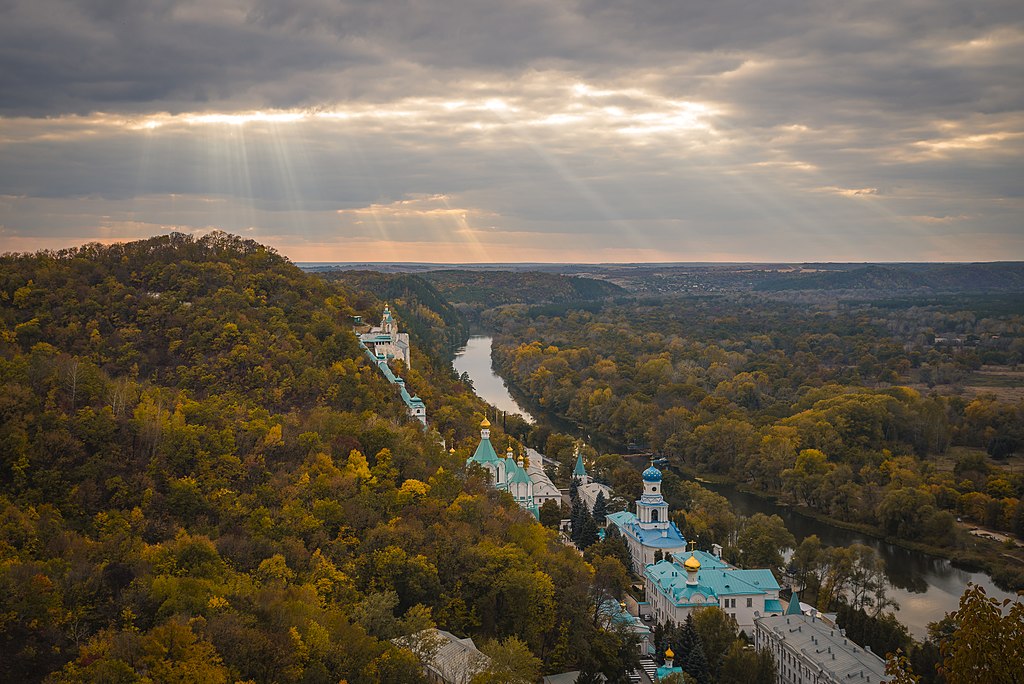
I assume that this work is essentially a piece of reportage, but have no particular proof of it. I do know that around the time that this story was published, Chekhov made a visit to a monastery by the river Donets. (Possibly it was the Sviatohirsk Cave Monastery? Google it to see pictures!) In any case, a handful of Chekhov’s stories feel more like lightly fictionalized pieces of reportage. One of these is “The Bird Market,” which is a lovely portrait of a street market in Moscow. Like “Easter Eve,” it exudes a gentle beauty.

 A Chekhov Circus